HMI Users View
About
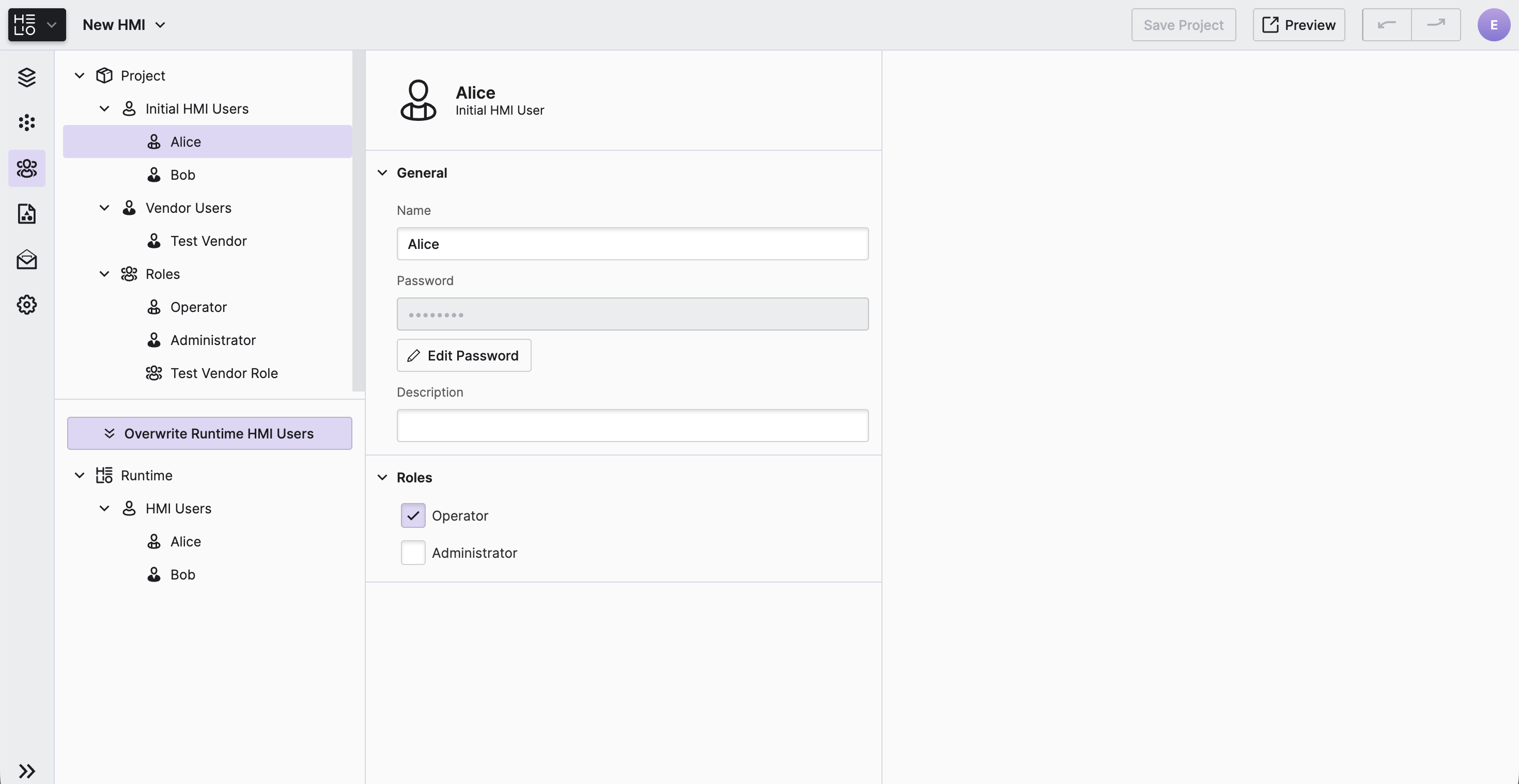
Use the HMI Users View to configure the HMI Users and Roles
for your project. Roles allow you to control access to pages, data variables,
and recipes within your HMI.
What's the difference between IDE & HMI Users?
Before we start, it is important to understand the difference between IDE Users and HMI Users in HELIO. Let's have a look at their differences:
| IDE Users | HMI Users | |
|---|---|---|
Who? | You and your team will using their | Once your HMI is deployed to the actual machine, the operators in the
factory will sign in as |
When? | While you are developing & engineering the HMI. | Once your HMI is deployed to the actual machine and running inside the factory. |
Where? | Use the IDE Authentication to define and configure IDE Users. | Use the HMI Users View of the Project Editor to define and configure Initial HMI Users & Roles for your project. |
Limitations |
| HMI users are only used for signing into an HMI. They can NOT be used to sign into the HELIO IDE. |
What's the difference between Project & Runtime?
Project — configure initial users, vendor users, and roles. These are design-time settings that seed the runtime user database on first start.
Runtime — the live user database created when the project starts.
It cannot be edited from the IDE. Use Overwrite Runtime Users to
reset it back to the initial project state.
Project
Initial HMI Users
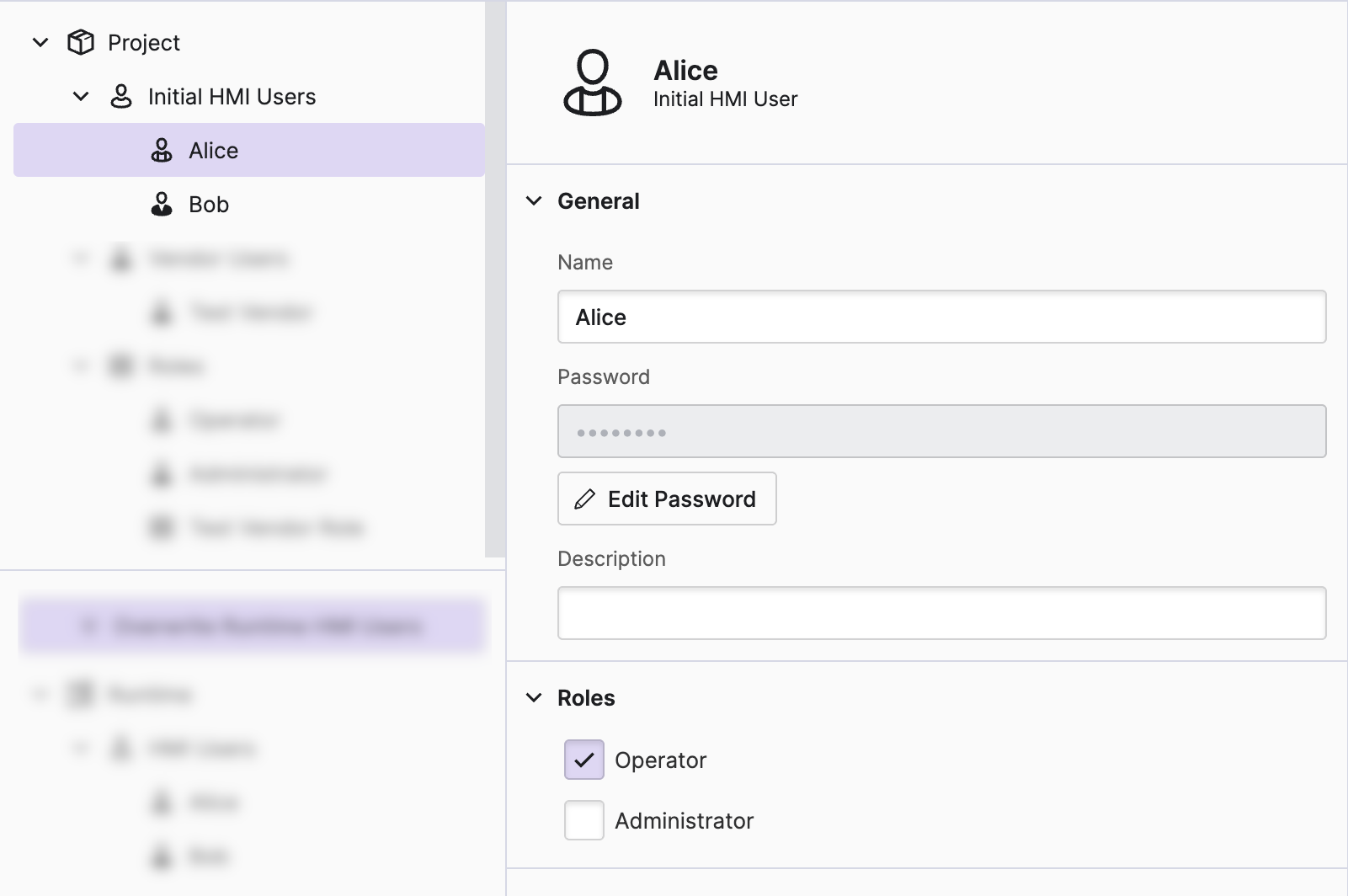
The Initial HMI Users are seeded into the runtime user database on the first
start of the project in a HELIO Runtime.
Once the user database has been initialized, the Initial HMI Users can no
longer be managed from the HELIO IDE. Any changes made to the runtime database —
such as edits or deletions via User Management Page —
will not be reflected back to this list.
Properties of an HMI User
Name
The unique name to identify this user. Displayed on the
User Management Page and in the Authenticate User
dialog (via Show Dialog Action).
Password
The initial password for this user. It can later be changed by the user
themselves or by any user with a role that has the Manage users permission.
Description
An optional description for documentation purposes.
Roles
Assign one or more roles to this user. Roles control what pages, elements, and data variables this user can access or interact with.
Roles
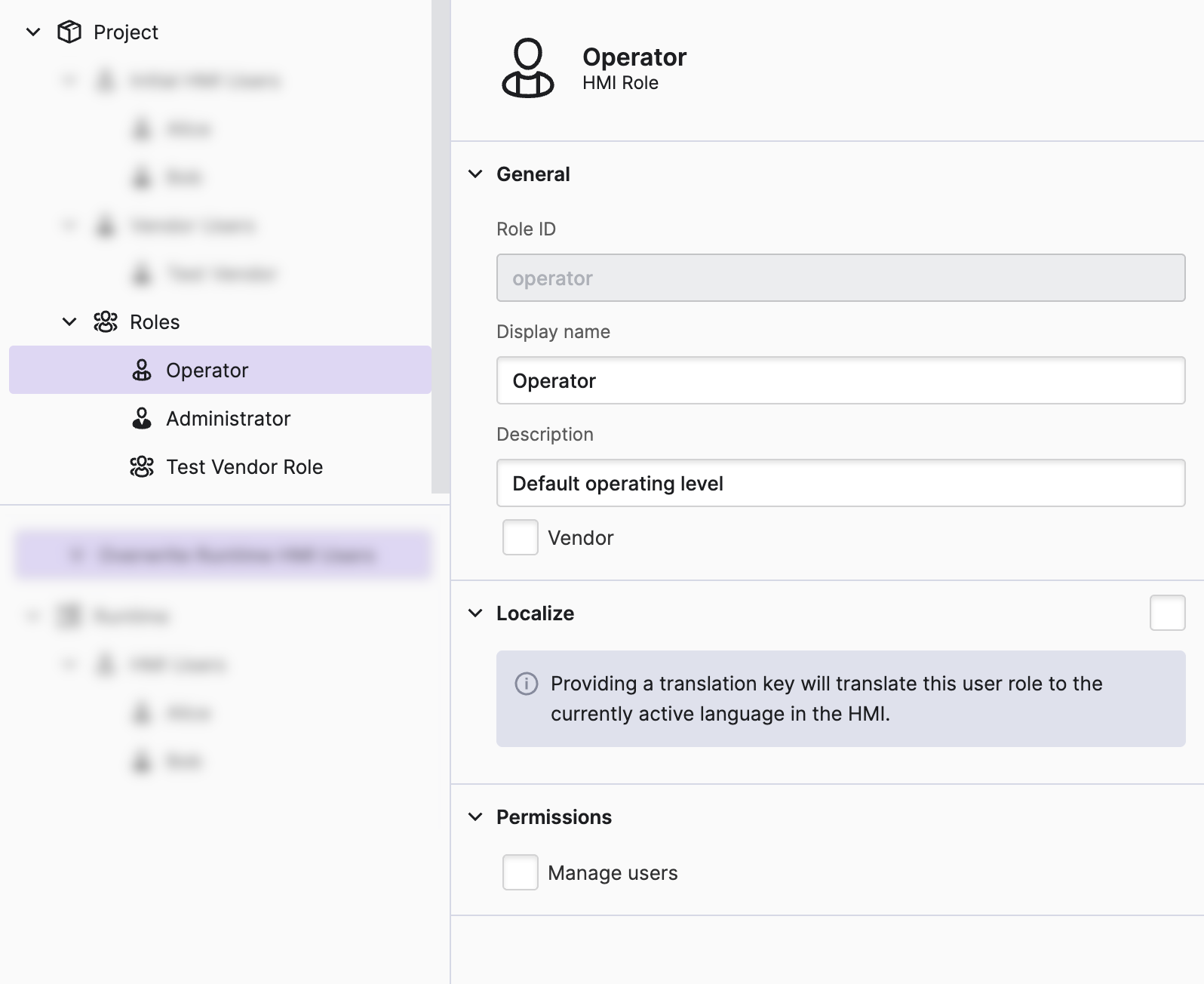
Roles are the building blocks of access control in the HMI. Assign them to users to:
- Restrict access to Data Variables using Restrictions
- Hide specific pages and elements using the Display Condition
- Disable elements using their
Is disabledproperty - Restrict access to recipes using the Recipes View
Properties of a Role
Role ID
Internal role ID that is used to uniquely identify this role.
Display name
The name that will be displayed on the User Management Page
and the dropdown in the Authenticate User dialog (via Show Dialog Action).
Vendor
Hides this role from the User Management Page so customer administrators cannot assign it to users. See Vendor Users & Roles.
Localize
Enable this feature to translate role names displayed on the User Management Page or in elements using the User Information into the active HMI language.
Translation key
Select the translation to be used for translating this role.
Permissions
Manage users
Allows users with this role to manage HMI users via the User Management Page.
Vendor Users & Roles
Machine vendors can use Vendor Users to pre-configure service or maintenance
accounts that survive customer administration. Because vendor users are hidden
from the User Management Page, HMI administrators on the
customer side cannot delete or edit them — only the vendor can manage
them from within the IDE.
Similarly, Vendor roles can only be assigned to Vendor Users — customer
administrators cannot see or apply them, keeping vendor-specific access
completely separate from the customer's own user management. To create a Vendor
role, add a new role in the Roles section
and check the Vendor checkbox in the dialog.
Properties of a Vendor User
Name
The login name used to identify this user.
Password
The password for this vendor user. Unlike regular HMI users, this can only be changed from within the IDE.
Description
An optional description for documentation purposes.
Roles
Assign one or more roles to this user. Assign a Vendor role to grant
access that remains hidden from the User Management Page.