Create a Basic Dynamic Property
This guide walks you through creating a custom Dynamic Property using the createDynamicProperty() function.
1. Basics
Before creating the dynamic property, let's quickly review some basic concepts and terms you should know:
What Is a Namespace?
Namespaces make sure that every element, action, and dynamic property has a globally unique ID. They help prevent naming conflicts between the elements found in your Extensions. Think of a namespace as a unique prefix that helps keep your code organized and conflict-free.
It's like putting all the stuff from your extension into its own folder so it doesn't accidentally clash with anything else in your HELIO projects.
Why Do Namespaces Matter?
Take, for example, a custom element named StatusIndicator. Multiple developers
or even multiple companies might use the same names for such an element.
Without namespaces, that could lead to conflicts or unexpected
behavior. By giving your extension its own namespace, you make sure everything
stays clean and separated — no mix-ups, no surprises.
What Does a Namespace Look Like?
Your namespace becomes part of the unique ID of your Custom Elements.
So in our example, the custom element named StatusIndicator is part of the
my-extension namespace of your company. So the namespace would be
com.my-company.my-extension and the actual ID of your element will be:
com.my-company.my-extension.StatusIndicator. This ensures that this ID will
never collide with elements from other extensions, or companies, even if other
extensions use the same element name StatusIndicator.
What Is a Dynamic Property?
Some properties have an additional secret superpower: the users of your extension can change their types. These properties are called Dynamic Property. See Dynamic Property Basics for more fundamentals.
Even better, you can even define your own custom Dynamic Properties and make HELIO even more tailored to your needs.
What Is a Props Schema?
A Props Schema lets you configure the API for whatever you build with the SDK — like Custom Elements, Custom Actions, and custom Dynamic Properties. It lets you control what properties your users can configure in the HELIO IDE.
These properties will show up in the Properties Panel of the Project Editor whenever an item of your extension is added or selected.
You define a props schemas by using the createPropsSchema() function.
Props Schemas Specify
- What properties are available and how they are called
- The types of these properties (text, numbers, etc.)
- The default property values for new instances
- Validation rules
2. Example
Here's an example of a basic custom dynamic property.
import { createDynamicProperty, createPropsSchema, values } from '@hmiproject/helio-sdk';
import { namespace } from '../../namespace';

export const basicDynamicProperty = createDynamicProperty(namespace, {
  name: 'Basic Dynamic Property',
  description: 'Read-only dynamic property that displays a single value',
  icon: { name: 'Default' },
  propsSchema: createPropsSchema().initial({}),
  writable: false,
  valueTypes: ['NumericValue'],

  useDynamicProperty() {
    return {
      valueType: values.Number(),
      value: 123,
      displayValue: '123',
      canRead: true,
      canWrite: false,
    };
  },
});
L1Import the createDynamicProperty() function for defining dynamic properties as well as more utilities supporting it.
L2Every dynamic property needs to live within a Namespace to prevent naming conflicts. Check out Create a Namespace for more details.
L4Use createDynamicProperty() to create the property in your namespace and export it so you can later use it in other modules.
L5-7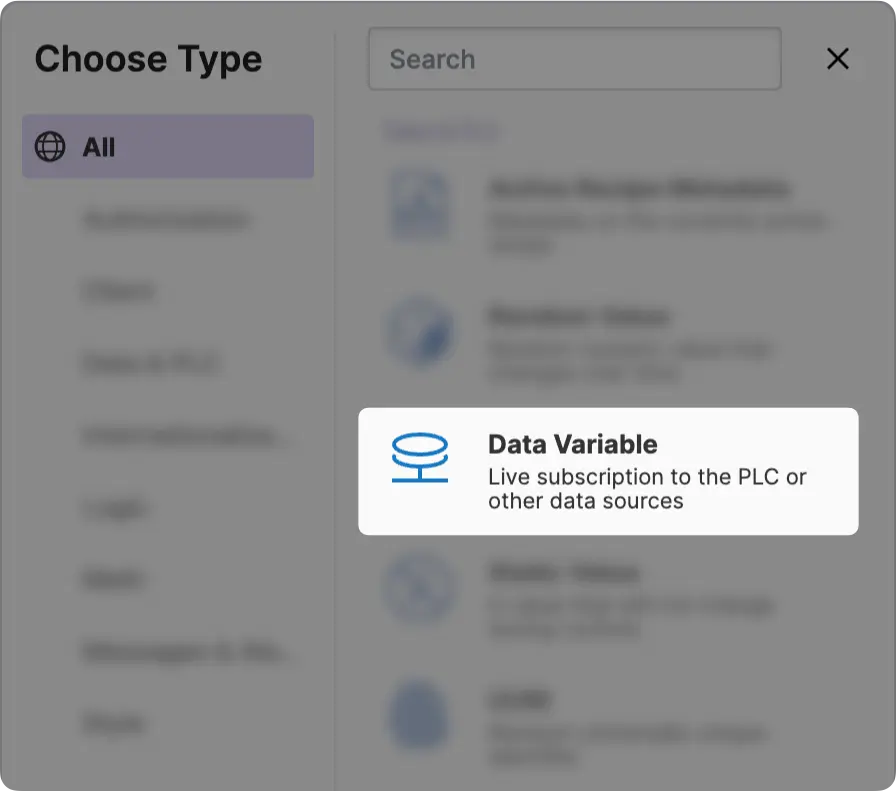
L8Props Schemas let you make your custom properties configurable.
L9Dynamic properties can be read-only or writable. Writable properties can
accept user input from elements like Magic Input.
This property however is read-only, so writable is set to false.
L10Each dynamic property can declare what types of data it can produce. This impacts where the property can be used. For example, a property that produces numeric values will be accepted as the value for Magic Output.
L12-20The useDynamicProperty function defines how your dynamic property behaves
and what data it provides.
L14Define the actual value type that this property currently produces. It must
match one of the types declared in valueTypes. In this case, you use
values.Number() which matches the NumericValue type.
L15The dynamic property's raw value.
L16The dynamic property's display value in human-readable format after all formatting has been applied. This must always be a string and is only used for display, not for data entry.
L17Properties can individually enable/disable read permissions based on custom logic. In this example, these are set to static values. In more advanced scenarios, you could compute these dynamically based on user permissions or other runtime conditions.
L18Properties can individually enable/disable write permissions based on custom
logic. Since this property shall be read-only, canWrite is set to false.
Congratulations! You now understand the basic structure of a custom dynamic property.